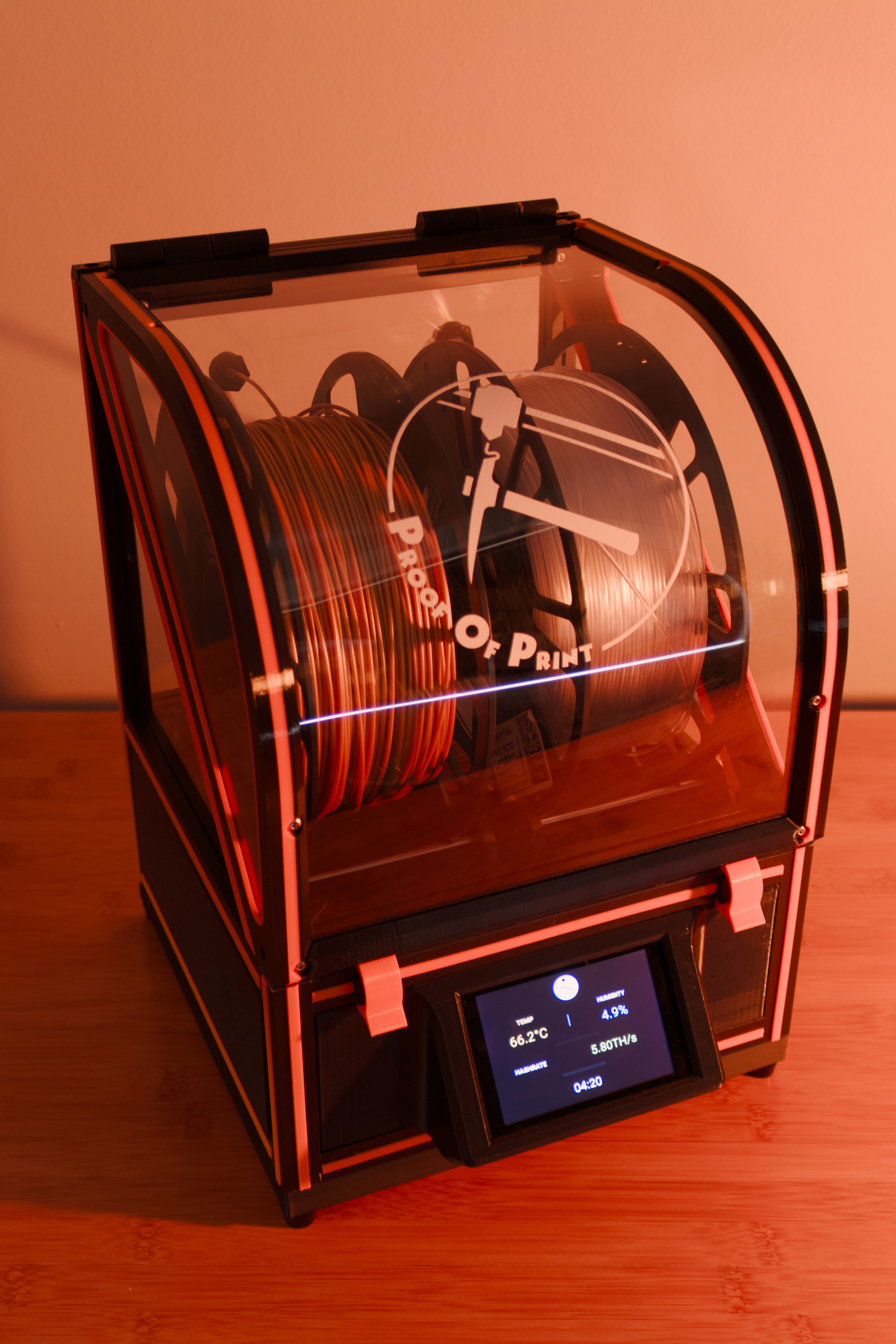
I built a two-spool filament dryer around a Canaan Avalon Nano 3S. The miner supplies the heat and produces about 6 TH/s while drawing roughly 140 W.
The build
The project started on March 22, 2026, after I secured a table at Rocky Mountain RepRap Festival. I showed a working demo there on April 18 and 19.
The enclosure measures 230 × 230 × 330 mm. I replaced the stock three 50 mm fans with two 80 mm fans to make room for the ducting. The curved lid helps spread airflow across the spools.
The controls use a Raspberry Pi Zero, a 3.5-inch touchscreen, and an SHT31-D humidity sensor. The Pi communicates with the Nano 3S over Wi-Fi, using the printer prototype's hotspot.
Why use mining heat?
Filament absorbs moisture from the air. Wet filament can cause steam bubbles, inconsistent extrusion, stringing, poor layer adhesion, and rough surfaces. Nylon and TPU are especially sensitive to moisture.
Drying needs controlled heat and airflow. A small miner can provide both useful heat and hashrate at a similar power level to a resistive filament dryer.
Design notes
The Nano 3S made this build possible because its firmware and API expose temperature and hashrate data and allow external control. That gave me a way to monitor the miner and build a separate touchscreen interface without replacing the miner's firmware.
The current version uses low, medium, and high power modes. The next control step is to use dryer temperature and humidity as feedback, then adjust the miner's output directly. That should give tighter control than fixed power settings.
Current status
This is a working prototype. The hardware fits in a compact enclosure and holds a useful drying temperature, but the control system still needs refinement. Longer term, I want to release the files so other people can build on it.
The original community discussion is on HeatPunks. For additional photos, add files under public/images/projects/filament-dryer/ and reference them here with Markdown image links.